


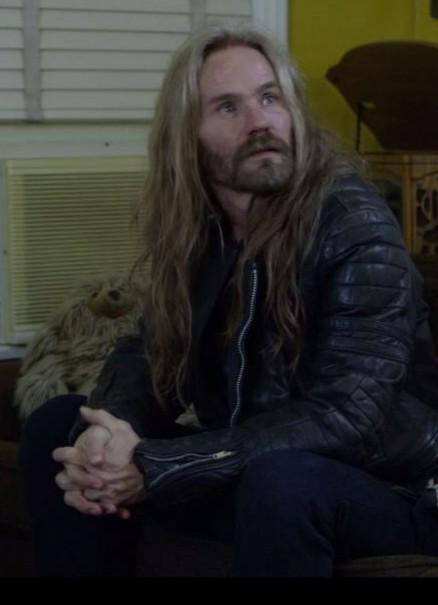
 Some may find it insulting, some may find it not so clever, but everybody no matter what are their beliefs or standards will laugh until they cry at least a couple of times. The short film – Jesus rides a Harley represents a highly comical parody of bikers, religion and state in society all in total. Story could be understood in many ways, and everyone will have their own understanding of it. The film had only one goal and that is to entertain the public by making them laugh their face off.
J.C. (Michael Boston) seems like an ordinary L.A. man. One night his motorbike started having some problems and he went on looking for a mechanic to fix it. J.C. mistook address and accidentally met Alina (Kay Wilson). Two of them fell really quickly into the highly intimate relationship. Alina was actually thinking that J.C. is Jesus from the first time she saw him at the door. That part of the film has small but highly comical elements and will be probably the public’s one of the favorite parts.
J.C. was actually a peaceful biker that focused his attention solely on his Harley. People that suddenly happened to be in his surrounding proclaimed him Jesus, that even he started to believe in it.
There are a few important things that this film is trying to deliver to us. You can be both what others think you are or what you believe you are, the choice is yours. Also, you can become and do anything you want, you just have to believe. Woman in a man’s life is important, because as it is depicted here, woman can make any man feel saint-like.
Acting was just as it is supposed to be for this kind of movie. The main characters did an amazing job in fulfilling the directors (Michael Bolton) wishes and realized all of the ideas that make this short film entertaining for the public.
At some moments the film has elements and a sense of humor that could be found in old British comedy movies that were making fun out of religion. What is surely represented in this film is the state of the mind of masses that is almost no different than the state of mind of the people that crucified Jesus. People need and want to believe, but when you provide them miracles they tend to attack you both physically and verbally because their simple minds cannot comprehend that. Even when the provided request to perform a miracle is fulfilled, that was proof that he indeed is Jesus the mass still made fun of him and continued with further provocations. The comedy becomes greater when the Jesus expert (Piankhi Iknaton) comes to evaluate J.C. (Michael Boston) if he is really Jesus.
The film looks like it has been made as a memorial for a friend that died in the accident.
But hey, the most important message that this film is sending is that all bikers go to heaven.
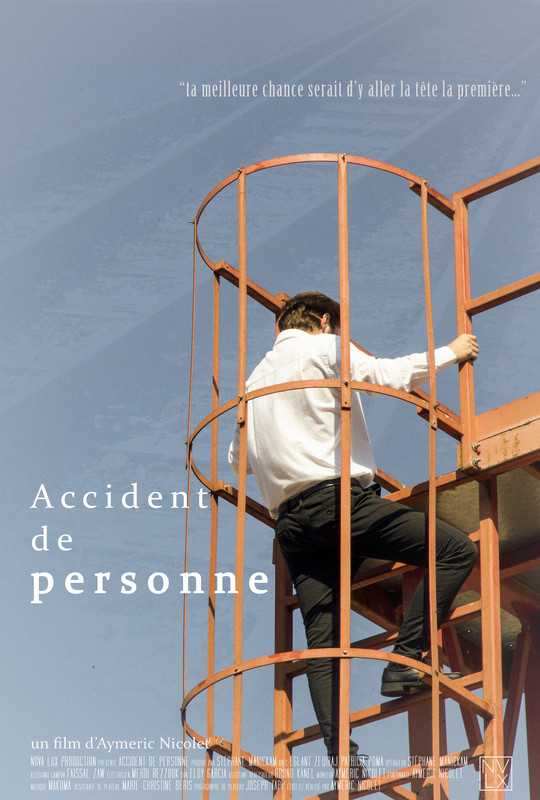 Accident de persone (Person’s accident) is the short film that managed to turn darkness into light, sadness into the way of happiness and total emotional breakdown to hope. This short film also leaves us with many questions about the possible meaning of the story. The suicide is the most obvious one. When all things go down in your life, some people just cannot find the meaning anymore and the suicide represents the only way out all of the problems. But what is the deeper meaning? What does the main characters (Eglant Zeqiraj; Patricia Poma) represent? The meaning of the story is surely deeply philosophical. Obviously, he is not looking for attention by talking about suicide, which is clearly depicted by the main character simply laying down on the train tracks. By his way of acting it looks like he is suffering from depression. He is coming from work, which can be concluded by the look of his bag and the way he is dressed. Maybe he fell deep into the claws of existential crisis, because of endless hours and days of precious life that he has spent working something he understood pointless, as something that is just prolonging your suffering. From the scientific point of view doctors, lawyers, dentist and psychologists are more likely to commit suicide. It could be that none of this is correct, maybe he was just lonely and he could not take the loneliness anymore. The loneliness could be the main reason for his “failed attempt” to commit suicide, because he reacted to the girl’s voice and almost immediately stood up from the train tracks. Why would someone care about his belongings if he has decided to commit suicide? The girl is probably also suffering from loneliness which we find out in the end (her father’s accident) at the same place the suicidal man was lying down. Is that the reason that she knew that he is not going to jump? In some moments this film is becoming tragi-comic, for example when she is suggesting him to jump. She knew he was not going to jump and also, she didn’t reply to his question in order to make watcher think. Outcome of her actions were more than positive. She saved a life, made a new friend and in time maybe something more.
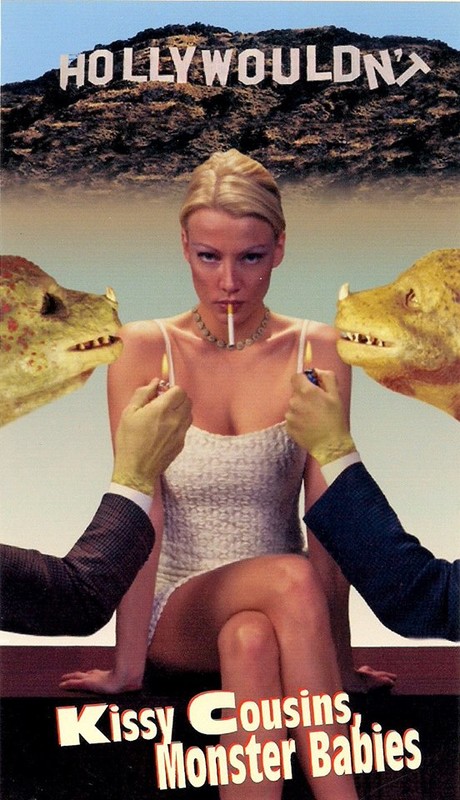 Two friends, Hollywood producers are trying to save their business from bankruptcy and their careers from decaying by attempting to create an idea about ideal blockbuster out of old successful movies that will save them and bring them back on top. Two of them are imprisoned in their ideas, that aren’t original at all. Putting faith into remaking the existing blockbusters by adding their ideas is just spinning them into the enchanted circle. Even when they finally come up with something, they believe will be great, they do not know that all of their ideas are being stolen, and their struggle is for nothing but comedy. Hunting from ideas based on the famous fictional character like Charlie Champlin, Nosferatu and Sharon Stone makes this short film highly enjoyable for all types of public. The beginning of the film looks like it has been shot in the 80s and the end in the present. One of the aims of the director (Wayne J. Keeley) could be that he was trying to give us a flashback to the “old times” and make us never to forget it. Honestly, if that was his aim, he did an amazing job. The idea was very well organized and even better realized. Maybe all of that is just a result of “anomaly” created by the shooting span, created spontaneously. Even if that is the reason, it still represents a great work that will be trapped for a long time in the minds of the public.
 In the film, the images attempt to match the directives espoused in the essay. We see figures move through time and space, at different locations all over the world. A young woman travels through the park, a library, and through complicated hallways and staircases. The film is accompanied by beautiful recordings of Bach, Schubert, and Brahms, unsurprisingly, since the students and teachers involved in the piece are musicians. However, the images seem to suffer from a sense of literalness. The essay asks us to look up (metaphorically, one assumes), and the figure in question looks up. While some of the film’s images do attempt to reach toward the sublime, most stick with moments of quotidian existence. While that is fine, and may, in fact, be part of the short work’s larger gesture toward the responsibility of each individual to work toward understanding the essence of himself and the world. However, the film would be more successful if it gestured toward the essence of cinema, which has long been thought to reveal meaning through metaphors rather than literal interpretations.
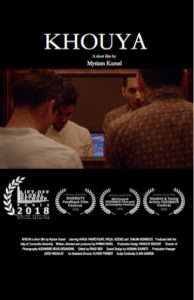 Kamel’s success lies in her steady, almost motionless camera, which allows the characters to show their complicated and wavering emotions. Youness’s attempts at rebellion seem small (wearing a collared, patterned button-up shirt instead of a white one), but the glances of disapproval through the mirror speak volumes. It’s a credit to Kamel that the film is as controlled as it is; its slow, cinematic tension matches the fractious relationship between the two brothers. The film’s sparse dialogue and few scenic changes allow Youness’s struggles to be internal, almost invisible. In this way, the gesture of tying a tie or adjusting a collar takes on a far greater significance than it usually does.
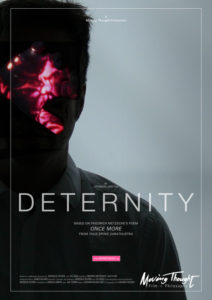 Mersolis Schöne and Evi Jägle’s “Deternity” establishes itself through a discomfiting “video” or “installation art” aesthetic, with its flexing animations and projections creating a vibrancy (albeit unattainable) in the background while a more dystopian, existential anxiety is conveyed in the foreground through clinic-white textures and silhouetted movement.
 Adrian Rodriguez’s “Ariadne” is certainly a visually accomplished film, one that mines the beauty and strangeness out of its mythological underpinnings.
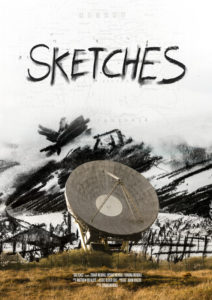 With a mix of disembodied archival dialogue and footage, lucid cinematography, and a generally contemplative pace and wandering structure, Zuhair Mehrali’s “Sketches” delivers a beautifully realized, experimental portrait of a fractured cultural / geographic history.
 Joel Thompson’s “Yummy!” presents itself as a whimsical game between brother and sister, with choir-like, fairy-tale music scoring the scene. The characters are light-heartedly sketched out as well: a timid, seemingly innocent brother and a confident, scheming sister. The narrative is also straightforwardly clever as it is revealed the game is indeed more “high-stakes” than previously assumed. However, where “Yummy!” falters is in its cinematographic execution; its visual appearance is textureless and under-defined, its dialogue inconsequential due to poor sound design, and the performances unconvincing due to ineffective direction and, ultimately, a missed opportunity in terms of using the space in the frame to a satisfying potential and building the lore of the atmosphere that is hinted at through the music and the narrative arc. As a result, the final moments fail to create their intended effect on a viewer and the film overall fizzles out quite forgettably.
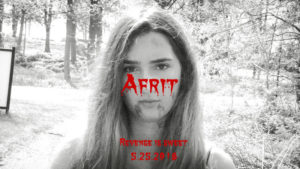 Richard Schertzer’s “Afrit” certainly makes a noble attempt at building dread with a nervous, repetitive strumming over its visuals. Additionally, there is some compelling shot composition in tracking shots and close-ups of characters’ physicality. Unfortunately, this is not enough to develop the characters themselves, who remain quite devoid of personality because of a lack of atmosphere (textureless cinematography) and a sparse script, one that does little to convey the stakes of the situation, as well as how we, as viewers, are supposed to interpret (or even feel about) the characters in the midst of it all.